|
|
 |
Thyrotoxicosis
|
 |
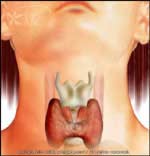
Normal |
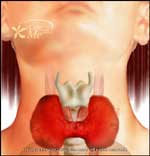
Abnormal |
|
|
-
The thyroid gland produces the thyroid
hormones triiodothryronine (T3) and thryroxine (T4).
T3 is the more active form, while T4 is partially converted
to T3 when released in the blood stream. The thyroid
hormones regulate metabolism throughout the body. The
pituitary gland releases a hormone (thyroid stimulating
hormone) that controls the release of the hormones from the
thyroid. Grave's Disease ,
which is the most common type of hyperthyroidism, is associated with enlargement and dysfunction of the eye sometimes. In addition, a heart arrhythmia called atrial fibrillation may occur with hyperthyroidism (President George Bush had this while in office)
|
 |
- Nervousness
- Anxiety
- Heat intolerance
- Increased sweating
- Fatigue
- Sweating
- Weight loss
- Muscle Cramps
- Diagnosis
- Lid lag
- Enlarged eye balls
- Heart racing
- Heart Palpitations
- Moist warm skin
- Hair loss
- Thinning nails
- Increased bowel movements
|
 |
- Ophthalmoplegia
- Increased pulse
- Irregular pulse
- Clubbing/swelling of fingers
- Bruit over thyroid gland
- Tremor
- Blood tests T3, T4, thyroid resin uptake, and free Thyroxine are usually all
increased.
- 3rd generation TSH is low
- Antimicrosomal or
antithyroglobulin antibodies are usually elevated
in Grave's Disease
- Radioactive iodine scan shows diffuse
disease (thyroid uptake performed at same time to calculate
dose of radioactive iodine that may be needed for treatment)
- Sedimentation rate is usually increased in Subacute Thyroiditis
- Imaging: MRI of orbits to evaluate
extraocular eye muscles in Grave's Disease
|
 |
- Propranolol treats the symptoms
and decreases the conversion of T4 to T3
- Methimazole
- Propylthiouracil
-
Radioactive iodine (swallowed) -- this treatment can
result in a permanent cure, but should not be given to
pregnant women or those under 25 years old. Lifetime
thyroid supplementation after treatment is often
needed.
-
Thyroid surgery is usually done for pregnant women or
those not candidates for radioactive
iodine.
- Surgery or radioactive iodine (see guidelines
above)
- Propranolol
- Radioactive iodine is effective in
large doses
- Surgery can be done, but usually
only for those not qualifying for radioactive
iodine.
- Propranolol and anti-inflammatories for symptoms.
This condition usually resolves itself.
- Graves' ophthalmopathy -- there is
no treatment for mild cases. Prednisone is given for
more severe cases. In cases that fail to respond, radiation
treatment or surgical decompression may be considered.
Artificial tears are used if the patient's eyes are
dry. The eyelids are taped shut during sleep if lid
lag keeps them open.
- Atrial fibrillation
is usually reversed by treatment of hyperthyroidism.
Propranolol and Digoxin may be used. If complications
persist after treatment for hyperthyroidism, electrical
cardioversion or long term anti-coagulation may be needed.
- Congestive Heart Failure -- same treatment as typical Congestive Heart Failure.
- Thyroid storm -- Propylthiouracil or
Methimazole every six hours, followed by Lugol's solution
one hour later. Propranolol is given intravenously.
Corticosteroids (e.g., Solumedrol) are given every six
hours. Definitive surgical treatment is performed only
after thyroid functions have stabilized.
- Hyperthyroidism in pregnancy -- Propylthiouracil at
the lowest dose possible. Surgery if Propylthiouracil is
not sufficient.
- Dermopathy (skin changes) -- topical corticosteroids with nocturnal plastic occlusive dressing.
|
 |
- Graves' ophthalmopathy --
lymphocytes (immune fighting cells in the blood) infiltrate
the muscles of the eye, resulting in the enlargement of the
eyeball, lid lag, severe dry eyes, and compression of the
optic nerve.
- Atrial fibrillation -- a heart irregularity that increases the risk of Stroke
- Congestive Heart Failure
- Thyroid storm -- an extremely severe form of hyperthyroidism that can be life threatening. The patient usually experiences Delirium, Dehydration, rapid heart rate, vomiting, Diarrhea and a high fever.
This is a medical emergency and is life-threatening.
If you suspect this condition, you
need immediate emergency medical treatment.
- Other complications include decreased libido, Impotence, decreased sperm count, enlarged male breasts, and a syndrome called periodic paralysis (sudden episodes of paralysis).
|
| | |
If you want your friend to read or know about this article, Click here
 |
|
|