
more about Hyperparathyroidism
Description
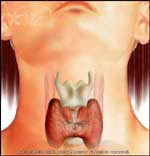 Normal |
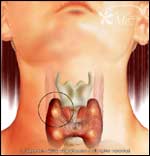 Abnormal |
- The parathyroids are a set of four tiny glands located inside the thyroids, separate from the thyroids in structure and function. They secrete Parathyroid hormone, involved in maintaining Calcium levels in the blood.
- Hyperparathyroidism refers to a condition in which these glands produce excess Parathyroid hormone, resulting in elevated levels of Calcium associated with “leaching” Calcium from the bones.
Symptoms
- Often none if mild
- Kidney Stones
- Back pain
- Joint pain
- Increased urination
- Increased thirst
- Loss of appetite
- Abdominal pain
- Nausea/vomiting
- Stomach ulcer
- Constipation
- Weight loss
- High Blood Pressure
- Muscle weakness
- Depression
- Psychosis
- Itching
- Numbness/tingling
Cause
- Hyperplastic (overgrown) parathyroid glands
- Parathyroid adenoma (benign tumor)
- Parathyroid cancer (rare)
- Multiple neoplasm syndromes
How the diagnosis is made
- Calcium and Parathyroid hormone serum levels are elevated, and the Phosphorus blood level is low.
- Make sure there is no lab error (e.g., high albumin level or Dehydration present to artificially raise Calcium level)
- 24-hour urine Calcium excretion may be high or normal and Phosphorus excretion high.
- Imaging — no imaging technique is ideal. MRI, CT scan, Nuclear scan, and Ultrasound may all be considered. Often do not know diagnosis until surgery.
- X-Rays of bones may show diffuse demineralization.
Treatment
- Severe Hypercalcemia — acute treatment:
-
- Intravenous saline with Lasix
- Pamidronate
- Corticosteroids for Vitamin D intoxication and Sarcoidosis
- Mild cases (i.e., Calcium level <11.0 mg/dL)
-
- Large fluid intake.
- Avoid thiazide diuretics and bed rest
- Phosphorus supplementation if kidney function is normal, but phosphate binders may be needed if kidney function is not normal
- Estrogen supplementation for post-menopausal women
- Severe cases:
– Surgical exploration and removal. Careful management of Calcium and Phosphorus levels post-operatively (they may drop very low).
Complications
- Pathologic bone fractures
- Urinary Tract Infections
- Kidney Stones
- Kidney failure (renal osteodystrophy)
- Stomach ulcer
- Pancreatitis
- Pseudo-gout
- Hypocalcemia in neonate
Similar Conditions
- Malignant tumors may secrete substance similar to Parathyroid hormone
- Multiple Myeloma
- Burkitt’s Lymphoma
- Sarcoidosis
- Excess Calcium ingestion
- Excess vitamin D ingestion
- Familial hypocalciuric Hypercalcemia
- Adrenal insufficiency
- Hyperthyroidism
- Bone fractures
- Acute kidney failure
- Vitamin A toxicity
- Paget’s disease