|
|
 | |
Liver
Cancer
|
 |
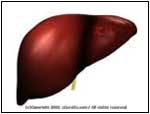
Normal |
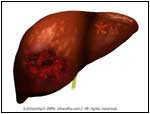
Abnormal |
|
|
- This is a disease process involving
toxins that chronically inflame the liver, increasing the
risk of liver cancer.
|
 |
- Sudden deterioration in patients with cirrhosis or liver
disease, specifically, weight loss, weakness, and abdominal
swelling (ascites)
|
 |
- A tender and enlarged liver
- Mass in the liver may be felt
- Bruit or friction rub over tumor
- Laboratory:
- Alpha-fetoprotein levels are elevated in 60% of the
cases
- Elevated white blood cell count
- Elevated hematocrit due to the tumor secreting erythropoietin
- Elevated alkaline phosphatase
- Arteriography -- dye is injected and x-rays taken, often diagnostic, to show a tumor "blush"
- CT scan with intravenous contrast
- MRI
- A liver biopsy is diagnostic
|
 |
- Surgical resection for small, localized tumors can be curative.
- Chemo-embolization (chemotherapy directed directly though the hepatic artery) may relieve symptoms.
- Injection of small tumor with absolute ethanol.
|
 |
- Metastatic colon cancer
- Liver cell adenoma
- Focal nodular hyperplasia
|
 |
-
Staging
(spread of disease)
- T1 -- tumor less than 2 cm
- T2 -- tumor less than 2cm that invades the blood vessels
- T3 tumor -- any tumor greater than 2 cm that invades the blood vessels, creating multiple tumors, no matter the size. Or any tumor greater than 2 cm (regardless of whether it invades the blood vessels) in one liver lobe.
- T4 -- multiple tumors in more than one liver lobe.
|
| | |
If you want your friend to read or know about this article, Click here
 |
|
|