|
|
 |
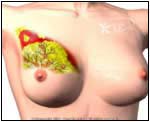
Normal |
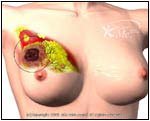
Abnormal |
|
|
-
Breast
cancer is the most common type of cancer in women, and the
second most common cause of cancer death in women (lung
cancer is most common cause of cancer death). During a
woman's lifetime, the risk of breast cancer is approximately
1 in 9. The United States has a very high rate of breast
cancer relative to many other countries. Though many factors
may play a role, a clear cause, such as diet, has not been
found.
|
 |
- Breast lump
- Nipple discharge
- Retracted nipple
- Red/inflamed nipple
- Breast enlargement
- Breast shrinkage
- Breast becomes hard
- Bone pain
- Back
pain
|
 |
- Breast Lump
- Nipple discharge
- Skin changes on breast
- Hardened breast
- Enlarged lymph glands:
- Above clavicles (collar bone)
- In armpits
- Sides of center bone in chest
(mediastinal lymph nodes might be enlarged inside the
chest, to the right and left of the midline)
- Mammograms
- Ultrasound
- CT Scan/MRI to check for spread to the brain
- Needle aspiration
- Mammatome test -- special type of needle biopsy with special X-Ray techniques to
localize deep lumps
- Open surgical biopsy -- when a
lump is removed and sent to the lab for analysis
- Lymph node dissection -- multiple
lymph nodes are removed to check for the spread of cancer
- Sentinel lymph node dissection --
a new technique in which only a few lymph nodes need to be
biopsied
|
 |
- Family history of breast cancer in
mother, sister, daughter, or if two or more close relatives
have the disease
- Risk increases as women get older
- Previous endometrial (uterine)
cancer
- Previous breast cancer, atypical
changes, and previous breast disease
- Carrier of BRCA1 or BRCA2 genes
(especially prominent in Ashkenazi Jews); however, only
5-10% of all breast cancers may be due to genetic defects or
changes.
- Menstrual periods started before
the age of 12
- Menopause ended after age 50
- No children
- Estrogen hormone replacement
therapy
- Alcohol, high fat in diet, increased fiber diet, smoking, obesity, and having previous ovarian or Colon Cancer
- African-Americans and Hispanics may
have a worse prognosis than
whites.
|
 |
- Breast cancer treatment depends on
three major factors:
- If the woman has reached menopause
- The extent to which the breast cancer has spread
- The cell type of the breast cancer
- The extent of the spread of the
cancer is defined accordingly:
- Where it is localized in the breast
- The rate of the cancer's spread to the lymph nodes
- The spread of the cancer to deep muscles in the
breast
- The spread of the cancer to the other breast
- The spread of the cancer to the other organs, i.e.,
bone or brain
- In terms of cell types, there are
more aggressive and less aggressive cell types. In addition,
there are receptors on the cells themselves (for example,
estrogen receptors) that make breast cancer more responsive
to treatment.
- Lumpectomy -- removal of the lump
and local tissue around it. This may include the removal of
some of the lymph nodes via radiation treatment.
- Segmental (partial) mastectomy with
or without radiation treatment -- involves the removal of
the cancer, as well as some of the tissue surrounding it.
The lining covering the muscles underneath the cancer, as
well as the lymph nodes under the arm, is also removed.
- Total mastectomy is done by
removing the entire breast and axillary (under the arms)
lymph nodes.
- Modified radical mastectomy --
removal of breast, the muscles below it, and lymph glands in
axillary armpit area
- Ovarian ablation -- making ovaries
inactive so they do not produce hormones that enhance breast
cancer growth. This is not commonly done, but new medical
literature suggests that it may be helpful in some cases.
- Medications
- Hormonal therapy -- Tamoxifen
- CMF (Cytoxan, Methotrexate, 5-FU)
and other agents of chemotherapy
- Bone marrow transplant
- Stem cell transplant
- Biological
therapies
|
 |
- Breast cancer is curable when
caught early, and can lead to death if diagnosis and
treatment are delayed. If you feel an abnormal breast lump
or have any other symptoms that might be suggestive of
breast cancer, see your physician as soon as
possible.
|
 | |
|
 |
- Monthly self-breast examination
- Yearly breast exams by your
physician
- Mammograms -- baseline
at 35 years old, and every 1-2 years between the ages of
40 and 49, depending on the risk factors. After 50, a mammogram
should be done every year. Mammograms may be recommended
in certain high-risk younger women.
- Vitamin D -- there is some
evidence that Vitamin D may be protective against breast
cancer. A dose of 400 I.U. per day is an appropriate
preventative measure.
- In some studies, Tamoxifen has
been shown to prevent breast cancer in high-risk women.
Tamoxifen does have side effects, including rare serious
eye problems and an increased risk of endometrial cancer.
- Evista -- this medication is currently approved for treatment of Osteoporosis (and
not breast cancer prevention). Many studies suggest it reduces the risk of breast cancer by 50% or more. It also seems to have much fewer side effects than Tamoxifen. Although there is no FDA approval, many physicians prescribe Evista for breast cancer prevention based on current medical studies.
|
| | |
If you want your friend to read or know about this article, Click here
 |
|
|