
Also known as
CREST syndrome or Progressive Systemic Sclerosis
Description
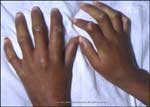
Abnormal
- Scleroderma is an autoimmune disease (body’s immune systems mistakenly attacks itself) characterized by diffuse thickening of the skin and internal organs. The cause remains unknown. Scleroderma may be localized, only affecting the skin. The disease can also be systemic, affecting the internal organs.
- There are two types of systemic Scleroderma, a limited disease called CREST Syndrome (80 percent of cases) and diffuse disease (20 percent of cases). CREST is an acronym for Calcinosis (deposition of lime salts in the tissues), Raynaud’s Phenomenon, esophageal involvement, sclerodactyly (hardening of the finger tips or toes), and Telangiectasia. In CREST Syndrome, hardening of the skin is limited to the hands and face.
- Death from Scleroderma is commonly caused by kidney, heart, or lung disease. The prognosis for CREST Syndrome is more positive. Scleroderma is seen between the ages of 30 to 50, and is more prevalent among women.
Symptoms
- Skin tightening and thickening is the hallmark symptom
- Swollen fingers and toes
- Joint pain and stiffness
- Hands may turn white when exposed to cold in Raynaud’s Phenomenon.
- Fever
- Fatigue
- Swelling
- Small, round, red lesions called telangiectasias
- Difficulty swallowing
- Shortness of breath and wheezing
- Chest pain on deep breath
How the diagnosis is made
- Mild anemia is present.
- Urinalysis (urine test) may show red blood cells.
- Pulmonary function tests may show a restrictive pattern of lung disease
- Esophageal manometry may show abnormalities in esophageal movement
- Chest X-Ray may show fibrotic changes.
- Elevated sedimentation rate and hypergammaglobulinemia are present
- ANA may be positive
- Rheumatoid factor may be elevated
- ACE levels, LE cell test, and cold agglutinins may be altered
- Scleroderma anti-body (SCL-70) is positive in up to 30 percent of the patients
- Anticentromere antibody is positive in 50 percent of the patients
Treatment
- Currently, there is no cure for this disease. However, there are treatments that exist to alleviate the symptoms.
- For Raynaud’s Phenomenon, Nifedipine or other Calcium channel blockers may be prescribed.
- For sores on the fingers and toes, Iloprost given intravenously may be helpful.
- For esophageal Reflux, head elevation, antacid, H2 blockers, proton pump inhibitors may be helpful.
- For bacterial overgrowth, the antibiotic Tetracycline may be prescribed.
- For hypertensive crisis, ACE inhibitors may be prescribed.
- Penicillamine is prescribed for rapidly progressing systemic Scleroderma.
- The medication Cyclophosphamide may improve severe interstitial lung disease.
- Support groups for Scleroderma help patients and family better understand how to cope with this disease.
Similar Conditions
- Eosinophilia-myalgia syndrome, which is seen in tryptophan toxicity (an old over-the-counter sleep remedy).
Miscellaneous
- Silicone Breast Implants and Scleroderma:
-
-
It has been questioned whether silicone breast implants are associated with Scleroderma. Current medical studies have not shown a connection.
- If you have silicone breast implants and any symptoms of Scleroderma, consult a physician or rheumatologist.
-